
The graffiti on the Lamont Harp was first publicly noted by Sir Phillip Christison in a booklet he wrote in 1969 for a series of publications on highland instruments by An Comunn Gaidhealach. In the booklet he suggests that the Lamont harp had ‘passed into the family of Stuart of Clunie, as scratched on it, in a childish scrawl can be deciphered ‘A C Stuart of Clunie His Harp 1650’.[1] This has led to much speculation over the identity of the ‘scrawler’, especially as the reading has more recently been reinterpreted as ‘A L Stewart’[2] and there are a number of ‘Clunie's’ especially in Perthshire and most of them can be shown to have had at some point a connection to families named Stuart/Stewart. However, from the harp's solid connection to the Robertson's of Lude the evidence provided by the family papers strongly suggest that there is no need to look beyond the place of that name connected to the ‘Lude’ family.
The ‘Clune’ in question sits on the north side of the River Garry and is bounded on its west side by the Lude estate and on its east the Allt Chluain (Clune Stream) provides a border between it and the Stewart held estate now known as Urrard. The name ‘Clune/Cluny’ is derived from the Gaelic cluain/cluaine meaning a pasture, green field or meadow; the reason that it is such a common name. But, to place Clune and the graffiti in context first requires a brief explanation of how it came to be held by the Robertson of Lude family. Originally it seems to have been part of the lands of the Robertsons of Strown/Struan, the senior branch of the Clan Donachach. It first appears being held by Tarleach or Charles a second son of the next senior branch of the Clan who held Lude. At this point due to some dubious moves by the Stewart Earls of Atholl they acquired the superiority of the Strowan lands so, the Tarlochson's of Clune moved under the superiority of the Earls of Atholl.
Subsequently a John Tarlochson of Clunes married Beatrix Gardyne and they purchased Inchmagranoch and it was again a younger son of that line, Alexander Tarlochson of Inchmagranoch, who in 1621 bought the barony of Lude from Campbell of Glenorchy and changed to using Alexander Robertson of Lude as his title. Meanwhile his older brother John still held his inheritance of Clune but in 1627 set it in Tack to Alexander, later confirmed as for the lifetime of the granter.[3] John seems to have died by 1640 when his son Patrick was consulted on the ‘boundaries of Clune’.[4] Alexander himself had died in 1639 leaving a young heir, also called Alexander, just as the political situation was about to explode with the wars of the three kingdoms. It is possible that he was still too young at that time to be served as heir to his father,[5] he was described as ‘quite a youth’ when he joined Montrose for the battle of Tippermuir in 1644. It is not clear how committed to the campaign in the longer term he was since further details are lacking.

Fig 1
An example of the name Alexander Steuart along with his wife Isobel Steuart written in a document dated 12 Jan 1655. His forename is contracted to Alexr and in both cases illustrating the interchangeability of the letters 'u' 'v' and 'w' the writer of this record uses a 'w' using the looped form which resembles a small double 'l'. Although enlarged here the names in reality in the original document are less than 25 mm in length.
[You may click on the picture to view a larger–sized image]
Certainly, having started on what eventually turned out to be the wrong side, (at least until the restoration), would not have helped him to legally establish himself as the heir to Lude and it took until the 16th July 1656 when he was, by an unusual route, served as heir to his father by Colonel William Daniel who was Cromwell's Governor of Perth.[6] The questionableness of that action is confirmed when on the 2 June 1671 he was served heir in the more usual manner in the barony by special retour, albeit post restoration now following the Scots legal process authorised by the Crown.[7] How all this affected Alexander's possession of Clune is unclear but there is a suggestion that the transfer of the Tack granted by his uncle John Tarlochson to Alexander's father presented some problems. For example, a document among the Lude papers dated 29 June 1642 gathers information for the laird of Lude concerning a dispute with the Earl of Atholl over Lude's rights to the lands of Clune.[8]
Once again further information is subsumed by the wider political situation but following the restoration and a return to ‘normal service’, by 1666 Alexander Robertson of Lude was paying ‘tack’ and feu duties for Clune to the Earl of Atholl.[9] Although the period up to and even for a little while after the restoration, was unsettled and lacks a lot of the normal administrative documentation, among the Lude papers there are some hints of the situation. It seems that taking advantage of Lude's problems, especially with the question of secure ‘titles’ Alexander's neighbours on the other side of the Allt Chluain, the Stewarts of Urrard had encroached into Clune and were even intruding into some of the Barony of Lude sheilings and peat cuttings. This led in 1657 to Alexander Robertson of Lude obtaining an act of Lawburrows against some of the Stewarts.
Lawburrows is procedure in Scots law whereby a legal surety or guarantee is required from someone that he or his dependants will not injure the person, or, later also, the property, of another or the latter's dependants, a kind of surety of the peace. That within the year Lude had complained of infringements points to continuing problems and it is tempting to wonder if due to a possible loss of men from the Lude estate as casualties of the Cromwellian wars the Laird of Lude was short of sufficient clansmen to resist the pressure from the Stewarts of Urrard. If as it seems there were problems with the Laird of Lude's hold over Clune which was the original Tarlochson holding and home of the MacEwan harpers then it is possible to see how the Lamont harp might have been part of the ‘property’ the Lawburrows was meant to protect.
When the graffiti on the harp is placed against that background and assuming the date of 1656 is relevant then it is possible to look for suitable candidates among the Stewarts on the Urrard lands. The original ‘Urrard’ in question were the lands of that name, Urrard Mor and Urrard Beg, which were west of the river Tilt heading towards Creag Urrard from which they clearly derived their names. They were also close to Blair Castle and like most of such properties were ultimately acquired by the earls of Atholl and are now part of the wider parks and gardens surrounding the castle. For example, as part of tidying up an anomaly created from when the earls of Atholl acquired by marriage, the thanage of Glentilt, it left Urrard Mor on the west side of the Tilt as part of the barony of Lude and Pitnacree on the east side of the Tilt in the earl's hands; an excambion was arranged in 1589/1590 between the earl and Patrick Ogilvy of Inchmartine the owner of Lude.[10]
The first association with the current place of that name was when Alexander Stewart Mac Robert of Urrard Beg married Christine Leslie. This lady was heiress to George Leslie of Renrory/Rinrorie (Raon Ruaridh), which lay between the Tarlochson (or Robertson) held Clune and the Robertson estate of Fascally. Over time the placename of Urrard replaced that of Renrory as the latter property became that Stewart family's main residence and their original lands of Urrard were absorbed as the Blair Castle mains farmlands. The earl of Atholl was the feudal superior of all these properties and further confusion was added when one of the first corn mills in Atholl was constructed at Aldclune and the earl created a ‘thirlage’. This was a system whereby all tenants in a designated area had to take their corn to that mill for grinding, irrespective of whether there were cheaper alternatives. In the case of the mill at Aldclune the thirlage covered 43½ merk lands of which 19½ came from the east side of the stream on land belonging to Urrard while 24 merk lands came from the west side of the stream and included the 12 merk land of Clune (Clunemore and Clunebeg combined).
The mill first appears in a charter in 1546, and both it and it's lade were in fact on the Urrard side of the of the stream and it was held under feu by a family of ‘Stewarts’, who like many of the ‘Urrard’ Stewarts also used Alexander as a common forename. However, if the date of the graffiti is taken at face value and it was a juvenile effort there are few identifiable ‘Alexander Stewarts’ who fit that date, other than one very speculative individual. Among the Urrard papers at the National Records of Scotland are some manuscript notes on the Stewarts of Urrard. It starts with Alexander Stewart Mc Robert of Urrard Beg and his wife Christine Leslie of Renroy and list their four sons, Robert the heir, then Neil, John and George. It adds that John died in 1675 and was survived by his son Alexander.[11] Although this Alexander could have still been a youth in 1656, unfortunately there is no corroborating evidence for either his existence or the date of the father John's death.
The period around the apparent date of the graffiti written on the side of the Lamont soundbox was politically unsettled and the then ‘laird of Lude’ had chosen the wrong side, at least from the point of view that ultimately it was the forces of Cromwell rather than the crown which took control. Not surprisingly this disruption also affected record management and survival, as well as the property and finances of many people. In the case of Alexander Robertson of Lude having joined the royalists, Cromwellian soldiers burnt his house; presumably the original home at Balnagrew, (the site of the current Lude House which was built in 1837). It was not until 1663/64 that he could afford to rebuild it[12] so both Lude harps must have been elsewhere on the estate during that period, which of course includes the date of the graffiti.

Fig 2
This example of the name written in 1702 again has Alexander contracted to 'Alexr' with the superscript 'r' and by that period the surname 'Steuart' had settled to using the 'u'. In the document the name is less than 25 mm in length.
[You may click on the picture to view a larger–sized image]
From what records have survived it has been possible to provide some background to the period and personnel who might have had some involvement with the Lamont harp at the date included in the graffitti. However, there remain some reservations when the style of the graffiti is considered. The suggestion by Sir Phillip Christison that the name should be read as ‘A C Steuart’, that is with the ‘A’ and ‘C’ being initials was unlikely given that having more than one forename was a much later introduction. A more recent interpretation as ‘A L Stewart’ made while the harp was undergoing an examination at the National Museum of Scotland is more likely to be correct and it is a logical assumption that it is short for ‘Alexander’.[13] But there do not seem to be any precedents from seventeenth century or later documents for Alexander, or in what was a Gaelic speaking world, for Alistair, being shortened to just ‘Al’. The usual form of contraction during that period was ‘Alex’ with either a superscript ‘r’ or ‘d’.
The ‘surname’ of ‘Steuart’ as written can best be described as a mess although there is little doubt that is what it is meant to represent. ‘u’ and ‘v’ were used interchangeably and so sometimes was ‘w’ (which as the pronunciation suggests was originally a double ‘u’).[14] Of the two quoted readings, although he missed the ‘e’, the interpretation by Christison of the fourth letter as a ‘u’ is correct and concurs with the usual written form of the name at that time. However, the next letter which should be an ‘a’ and has been transcribed as such in both of the quoted readings is open at the top and more resembles a ‘u’ while the final ‘rt’ is almost contracted. Indeed, the graffiti does appear to have been written by someone unused to writing their own name, adding weight to Christison's suggestion that it was the work of a child.
While the concept that a child or even an adult, might be unused to writing their own ‘surname’ might be the antithesis of modern practice in this case it is not out of context. Although solid information is lacking the further back we go, as late as 1755 it has been estimated that only 1.2% of the population of the parish of Atholl spoke Scots, (40 out of a population of 3257),[15] so further back in the seventeenth century there is unlikely to have been more than a small percentage who were not monoglot Gaelic speakers while most of those who had been taught to write would have been working in a to them, foreign tongue of Scots. Although paper was cheaper than vellum, it was still expensive so schools used slate as the medium of tuition, and it is worth noting that the lightly written graffiti done with a sharp pointed tool on the Lamont harp would not have needed much more pressure than writing on slate.
Even having received some tuition in writing the next question is how often it was used and what for. Most written documents produced in seventeenth century Scotland were written by professional scribes for legal or financial (which includes estate management), purposes. For most people the requirement to sign a document was infrequent and in the Gaelic world it was in a form of your name rarely used, in the case of the writer of the graffiti he would certainly have been known as Alasdair with his patronymic rather than Stiubhart and almost certainly not as ‘AL Steuart’.[16] Therefor the background fits that of a young man having had some schooling but unfamiliar with using a ‘Scots’ version of his own name, but there remain the problems of the style of the rest of the inscription.
These are added to by the date where the last numeral seems to have been corrected from a zero to a 6. It is conceivable that someone could make an error following a change of calendar year, which in Scotland had from 1600 commenced on the 1st of January, but to be six years out seems unlikely. It is a mistake more likely to be made when calculating back to the date of an event in the past. If it was the case that the graffiti with its date were not actually written at the period the date implies but later, then any reservations about the style fall away. It also means that although the background to Lude and Clune around that period is still relevant to the reason for the inscription having that date, the search for the background to the graffiti must be re-evaluated. That in turn leads to the early part of the eighteenth century and some potential evidence from the Lude archives relating to that period.
The surviving records from the time of John Robertson of Lude, the last member of the family known to have played the harp, provide far more material to work with than that for the Alexander Robertson of Lude contemporary with the 1656 date. However, while there are several points of interest, and it is tempting to join the ‘dots’, the evidence is not firm enough to rule out it just being coincidence, but it is probably worth noting them in any case. Over his lifetime John Robertson had several different servants with at least two of them called Alexander Steuart and one was certainly ‘housed’ in Clune.[17]
Some of the more relevant background comes from some small pocket notebooks apparently handmade and in two cases covered with flowered wallpaper and the third one with a reused old document. Kept by John Robertson they contain his daily financial records prior to transfer to a more formal account book and cover the last few years prior to his death in 1730. One two-page entry lists the delivery of peats, usually a requirement of their rents, by the tenants in ‘Brae of Clunie’ and Strathgroy. His servant Alexander Steuart is listed under the Brae of Clunie but also listed in Strathgroy is ‘John Clarsairs widow’.[18] The lady's husband must have died recently as he appears several times elsewhere, as either John Robertson alias Clarsair or just as John Clarsair. What may have been one of the last records of him was an entry in August 1727 to payments made at a ‘Grigar Murrays’ to a violar, clarsair and a midwife (probably a celebration of a birth).[19]
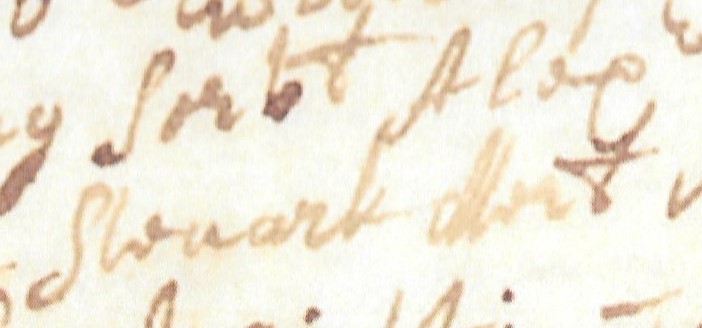
Fig 3
This example is from a document dated 1728 and is cropped to show the contracted name 'Alexr 'with superscript 'r', from one line and 'Steuart' from the line below. The word before Alexr is a contracted form of 'Servant' where the 'v' shows how 'u', 'v' and 'w' often start with a tall stroke. Like the other two examples in the original document the writing is small, some achievement considering they were using hand trimmed quill pens.
[You may click on the picture to view a larger–sized image]
The presence of the violar reflects the changing musical tastes even at Lude where in an earlier record of the Lairds expenditure in 1702, a treble viol and a bass were purchased, and money was given to a violar named as Walter McPharlan described as ‘infirm’ although there were also frequent payments to clarsairs.[20] However in those later notebooks apart from just that one payment to a ‘clarsair’ and the record of the widow, there were several references to violars including a William Catanach violar at Kilmaveonach[21] Clearly that part of Atholl was reaching the point where with the death in 1730 of John Robertson of Lude, the last laird known to actively play and support the clarsach, the instrument rapidly gave ground to players of the viol and violin.[22]
In the written Scots of the period capitals had no rules concerning where they were used and in most cases were simply larger versions of the usual letter forms, making the identification of capitals a subjective process. In the Lamont graffiti the apparent capitals, the ‘S’ and ‘C’ are closer to a much later style than the usual letter forms of the seventeenth century. Likewise, the absence of the ‘dropped ‘h’ and ‘long ‘s’ two letters which in the written Scots of the period would normally extend below the line. The ‘u’ in Clunie and the ‘a’ in harp are also atypical of the period. While the absence of writing standards and great variation in the written Scots hand of the period rules out a definitive comment on whether the date of ‘1650’ is consistent with the style, the large number of problematic letters do continue to raise questions.
Returning to the Lamont harp, when set against that background then it is possible to advance a speculative but plausible explanation for the graffiti. If the Lude servant in Brae of Clunie had a young son also called Alexander, any writing tuition he received would reflect the coming style of the future rather than that of the adult present. An immature youth would also be less aware of the protocols of style, for example the difference in describing someone as ‘of’ as apposed to ‘in’. From the Steuart home in the Brae of Clunie to the harper's widow's home and presumably her late husbands in Strathgroy, was no great distance, in highland township terms almost next door neighbours. Therefore, a neighbour's son would have been quite familiar with her late husband's instrument and with harps in general in decline in both use and at that time value, the instrument would have been open to both use and abuse.
This of course leaves the question of why then the retrospective date and here at least there is some factual evidence to support the speculation. Among the Lude papers there does survive a discharge dated 6 May 1656 from Mr Colin Campbell to Alexander Robertson of Lude for the teind duty of the ‘barony of Lude and the 12 merkland of Stragray’ (Strathgroy) for 1655.[23] The absence of the teinds for Clune seems to be a recognition that Alexander had not had sufficient authority to enforce the collection of teinds from the inhabitants of Clune. This may have been a factor why in the following month of June 1656, he followed the unusual route of approaching one of the Governors of what was Cromwell's military occupation of Scotland to obtain at least some sort of albeit irregular, confirmation of his heirship to Lude.
At that time the transmission of history among most of Gaelic society was purely oral and with mostly a local focus. A young lad would have heard the stories told by the older generations including how Clune was at one point ‘possessed’ by the Stewarts, the finer points of the law, that the incursion was illegal are unlikely to have registered in the stories.[24] If as seems likely the year of 1656 was the high point and Alexander Robertson's obtaining a formal recognition of his heirship of Lude was also the start of his regaining a firm grip on Clune then it would also explain it being a memorable date for the Stewarts.
It is important to emphasis that this argument is still speculation albeit informed, but whether simply coincidence or not, it does resolve the reservations regarding the style of the graffiti and links the few hard facts in a coherent fashion. In conclusion it is also worth noting that the fact Clunie visibly features in its history is not surprising as the Lamont Harp was associated with the marriage between an ancestor of the ‘Tarlochson’ line, John Tarlochson of Clunes to a daughter of Lamont of Lamont which also led to a branch of the MacEwan harpers also moving from Argyle to serve the Tarlochsons at their then holding of Clunie. It was also the expensive legal disputes with the Duke of Atholl over Robertson of Ludes rights to Clunes that led to the bankruptcy of the Lude estate and the forced sale after the death of General Robertson of Lude in 1820.[25]
[1] Christison, General Sir A F Philip. The Clarsach. An Comunn Gaidhealach (1969).
[2] Loomis, K. PhD thesis. The Organology of the Queen Mary and Lamont Harps. Vol 2 (2015). p. 266
[3] National Records of Scotland (NRS), GD 132/477 and GD132/491
[4] NRS GD132/62.
[5] In Scotland the age of majority is 16.
[6] Robertson, J A. Comitatus De Athola (1860). p. 51. According to a footnote in this source the service of heirs was in the Lude Charter Chest. It is certainly no longer among the Lude papers held by the National Records of Scotland. In 2012 I was allowed access to some Lude related items which were among the private archives of the Douglas-Home Family, Earls of Home and according to my notes made at the time it seems to have found its way there.
[7] Robertson, J A. Comitatus De Athola (1860). p. 51. As with the previous reference a copy of the original is said to be in the Lude Charter Chest, but there is now no trace of it. In this case there is reason to question if that was the case or indeed if J. A. Robertson saw the original because what he quotes om page 51 of his work although not stated to be the case clearly comes from some printed abridgements in two volumes containing the retours from 1530 to 1699 (published in 1811), with a third volume in 1816 containing the index, under the title Inquisitionum Capellam Regis Retornatarum Abbreviatio The original is recorded in NRS C22/31 f.309
[8] NRS GD132/63
[9] NRS GD132/592
[10] NRS GD112/25/57; GD112/2/114/1. In Scots Law an excambion is a process whereby proprietors can simply exchange pieces of land, usually of the same value, both 4 merklands in this case, without going through the process of sale and purchase. The 4 merkland of Pitnacree is not the better-known place of that name close to Grandtully in Strathtay but the place of the same name roughly halfway between the modern Lude House and the point at which the Fender Burn joins the River Tilt. At that time the Barony and Superiority of Lude were held by the Ogilvy's of Inchmartin.
[11] NRS GD 1/394/97
[12] NRS GD132/591A The masons account for building work done at Balnagrew. The house was probably burnt by Cromwell's troops after the royalist Major-General William Drummond used it for quarters in 1654. See the Royal Commission on Historical Manuscripts Report on the Duke of Hamilton papers, page. 136. Section 1. Number 1.
[13] See reference number 2 above.
[14] The interchangeability was one of the factors leading to some spelling variations, for example Stewart/Steuart and Struan/Strowan
[15] Withers, Charles W J. A Geography of Language: Gaelic-Speaking in Perthshire, 1698-1879. Transactions of the Institute of British Geographers, Vol 8. No 2. (1983). p. 131.
[16] A classic example of this point is provided by the Gaelic poet Alexander MacDonald, son of Mr Alexander MacDonald, Minister of the parish of Islandfinnan. Known among the Gaelic speakers as well as some speakers of Scots of the time as Alasdair Mac Mhaighstir Alasdair. It is also worth noting that even among lowland Scots speakers in colloquial speech people named Alexander were usually known as ‘Sandy’, ‘Sanders’ or in more modern times ‘Lexie’.
[17] Probably as what was known as a ‘cottar’ a tenant having a cottage and a small portion of land sufficient to keep a cow and usually living rent free as part of his salary.
[18] NRS GD132/372/1
[19] NRS GD132/372/1
[20] NRS CH2/694/10
[21] NRS GD132/372/1
[22] When Alexander Robertson of Faskally, the estate just on the other side of Urrard, died in 1731 his testament included his 'trible Violine and a Bass. NRS CC7/6/3
[23] NRS GD132/719
[24] The contrast between the vernacular view of events and reality is illustrated by the Black Book of Taymouth, compiled between 1598 and 1648 recording acquisitions of property by the Campbells of Glenorchy. In listing the achievements of one laird it lists all the properties added to the estate by as it puts it ‘conqesit’ (conquest), including that of the lands and barony of Lude and Pitnacrie in 1619. Now ‘conquest’ implies they were taken by force but from the contemporary records both family and public, we know that Lude and most of the other ‘lands’ listed were bought following the usual legal processes of the time. In the case of Lude it was sold to Campbell of Glenorchy by its previous owner Ogilvy of Inchmartine.
[25] The lands of Clune along with Strathgroy and Inchmagranachan were pledged as collateral for the dowry provided by the then Lude when his daughter Margaret married a son of Robertson of Fascally in 1673. Despite requests from Fascally for the money Lude was unable to redeem the three lands so in 1684 Robertson of Fascally ‘sold’ them to the earl of Atholl. This meant that Atholl who was already the Feudal superior of Clune and Strathgroy also became the owner and Robertson of Lude moved from owner to a position of the major Tacksman (hereditary tenant).
Submitted by Keith Sanger, 20 October, 2024.
Except where otherwise noted, content on this site is licensed under a Creative Commons License.
Permissions beyond the scope of this license may be available by contacting us at editor@wirestrungharp.com.
